Build a family emergency kit checklist for your household
Want to know how to build an emergency kit that actually fits your family? Enter how many adults, children and pets are in your household, and whether anyone takes regular medication. The tool below sizes a standard 72-hour kit checklist to fit, based on FEMA's per-person guidance.
8 min read
Build your kit
Tell us your household, get a sized checklist for a 3-day (72-hour) kit.
Build an emergency kit checklist around essential items, not everything you own
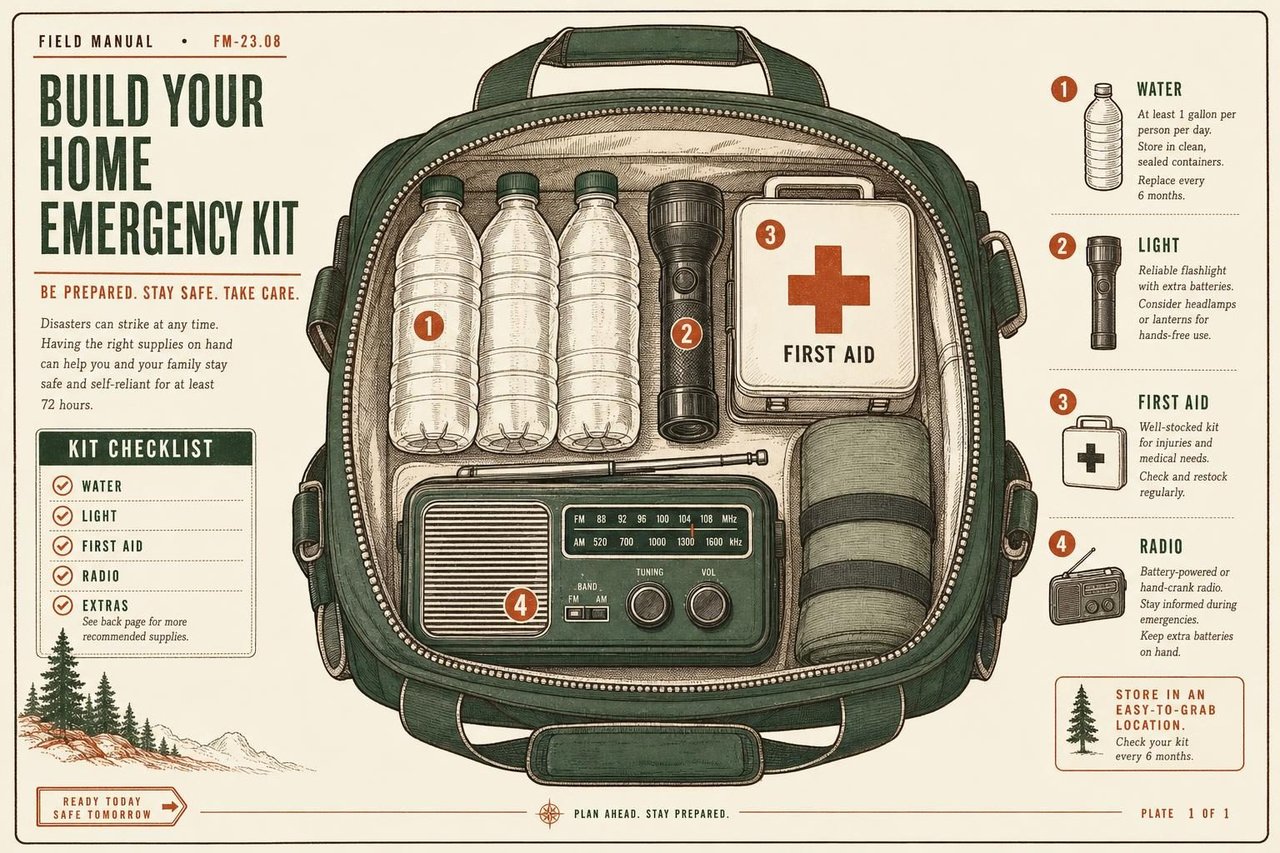
Every emergency kit checklist on this page starts from the same idea: build around essential emergency kit items first, then add anything specific to your family after that base is covered. Water, light, first aid and a way to get information are the essential emergency kit items nobody should skip; everything else is a worthwhile addition, not a requirement.
Why 72 hours is the standard planning window
Most official emergency-preparedness guidance, including FEMA's own Ready.gov program, uses a 72-hour (3-day) window as the baseline for a home emergency kit. That's not an arbitrary number: it reflects how long it typically takes for utility crews, relief organizations, and local services to reach an affected area and restore basic services after a significant event, though any specific situation can take longer. A 3-day kit is the floor, not a guarantee that help will arrive by then. It's also exactly why the emergency kit checklist above is built around 72-hour quantities rather than a round number that sounds reassuring but isn't tied to anything real.
Knowing how to build an emergency kit that actually matches this window is less about following a long shopping list and more about getting the quantities right for the people who'll use it.
Building a kit sized correctly for your actual household matters more than following a generic list. A single adult and a family of five need very different quantities of water and food, and a household with a pet or a member on regular medication has needs a one-size-fits-all checklist simply won't cover, which is exactly why the tool above asks for your specific numbers before building the list.
The items worth understanding, not just checking off
Water: one gallon per person, per day
This figure covers drinking and basic hygiene, not bathing. Store water in clean, sealed containers, and rotate it roughly every six months. Stored tap water doesn't spoil quickly, but containers can degrade or pick up off-tastes over time.
Food that needs no cooking or refrigeration
A power outage is the most common reason a kit gets used, so the food in it should assume no stove, no microwave, and no refrigerator. Canned goods, dried fruit, nut butters, and shelf-stable protein bars are standard choices. Just remember the manual can opener, which is the single most commonly forgotten item in a kit built around canned food.
A radio with NOAA Weather Radio reception
A battery or hand-crank radio that can receive NOAA Weather Radio broadcasts keeps you connected to official alerts even if cell service and home internet are both down. See our guide to warning sirens and alerts for how this fits into the bigger alert picture.
Medication
If anyone in the household takes regular prescription medication, a kit without it is missing its most time-sensitive item. Keep a rotating 3-day supply specifically for the kit (not pulled from an active prescription bottle you need daily), and keep a written list of medication names, dosages and prescribing doctors — useful if you need an emergency refill from a pharmacy that doesn't have your full history on file.
Pets
Pet food, water, and a leash or carrier are easy to forget under stress, and many emergency shelters either can't accept pets or have separate requirements for them. Knowing your local shelter's pet policy in advance is worth five minutes now.
Keeping the kit current
A kit is only useful if it's checked periodically. Food and water need rotating roughly twice a year, batteries can corrode in storage, and a growing child's supplies (diaper size, clothing) go out of date faster than anything else in the bag. Pick a date that's easy to remember (the start of daylight saving time changes, for instance) and check the kit then. Our kit rotation tracker logs what's stored and when, and can add a calendar reminder for each item so this doesn't depend on remembering a date on its own.
A smaller kit for the car
A full 3-day kit isn't practical to keep in a vehicle, but a smaller subset is worth the trunk space if you drive often: water, a basic first-aid kit, a flashlight, a phone charger that works off the car's power, and, in colder climates, a blanket and basic winter gear. The goal is covering a few hours stranded, not a full 72-hour window; treat it as a supplement to the home kit, not a replacement.
A lighter version for a go-bag
If you also want a go-bag (a lighter, grab-and-go bag for a short-notice evacuation instead of a shelter-in-place kit), the priority list is narrower: copies of essential documents, a few days of any critical medication, a phone charger, cash, and one change of clothes per person. A go-bag is meant to be carried, not driven with, so resist the urge to pack it as heavily as the home kit.
What tends to actually get used, versus what sits unused
Anecdotally and in post-event surveys from emergency-management agencies, water, a working flashlight, and a charged power bank are the three items households report using even in relatively minor outages, well before anything resembling a full emergency. Food and first-aid supplies see heavier use in longer disruptions. This is worth knowing mainly because it argues for checking the flashlight batteries and power bank charge level more often than the twice-a-year full review — those are the items most likely to already be in use, and most likely to be dead when you reach for them if nobody's checked recently.
Involving the whole family in building the kit
For households with children old enough to help, letting them pack their own small section of the kit (a favorite book, a deck of cards, a stuffed animal) does two things at once: it gives them a sense of control rather than something being done to them, and it means the comfort item is one they actually chose, which matters more during an actual stressful event than one picked by an adult on their behalf.
Where the checklist above comes from
The base list the tool generates draws from FEMA's own published Ready.gov recommendations for a basic emergency supply kit, which is itself built around decades of emergency-management experience about what households actually need in the first three days after a disruption, before outside help typically arrives. We add the household-specific items (pet supplies, infant needs, medication) on top of that base list, not in place of it, since those additions are about fit, not substitution.
What a kit does not need to include
It's just as useful to know what to leave out as what to include. A kit doesn't need duplicate sets of every household tool, specialized survival gear built for scenarios far beyond a 3-day local disruption, or large quantities of anything perishable beyond what you'll realistically rotate on schedule. Keeping the kit to genuinely useful, regularly-checked items is more reliable than a large kit nobody ever opens to maintain.
Storage containers worth considering
A large, clearly labeled plastic storage bin with a secure lid protects supplies from moisture and pests better than a cardboard box or a loose pile of bags, and a lid that latches shut survives being knocked over far better than one that just rests on top. If portability matters more than maximum capacity (an apartment, a household that moves often), a sturdy duffel bag or backpack-style container is the more practical choice, even though it holds somewhat less than a rigid bin of the same footprint.
A reminder, not a rule
None of this needs to happen perfectly or all at once. A partially built kit started this week genuinely beats a perfect kit planned for someday — buy the water and the flashlight today, add the rest over the next month, and treat the checklist above as a target to work toward rather than a pass/fail test.
If you have limited space
A smaller home or apartment doesn't need a smaller commitment to preparedness, just a more compact one. Prioritize water, a flashlight, a first-aid kit, and any medication first (those four categories cover the bulk of what actually gets used) and treat the remaining items on the checklist as worth adding as space and budget allow. Don't skip the kit entirely because a full version doesn't fit.
A quick note on expiration dates
Bottled water doesn't technically "expire" in the way food does, but the plastic container can degrade over years of storage, which is the real reason behind the roughly six-month rotation recommendation: it's about the container, not the water itself. Food items in the kit should be checked against their actual printed dates at each twice-yearly review, and anything within a few months of expiring is worth rotating into regular household use and replacing; don't let it expire unused in the kit.
After you've built the kit once
The checklist above is meant to be revisited, not built once and forgotten. If your household composition changes (a new child, a pet, a new medication), rerun the tool and compare the updated list against what's actually in the bag. The tool's shareable link (the page URL updates as you change the numbers) makes it easy to send a specific version to a partner or family member so everyone's working from the same list when it's time to restock. Keep this emergency kit checklist bookmarked. It's meant to be used more than once.