A plain guide to emergency alert sound types and their meaning
What does the siren sound meaning actually come down to? Outdoor sirens, phone alerts, weather radios and TV interruptions all sound different, and none of them are standardized the same way nationwide. Here's what each one is for, and exactly where to look when you hear one and need the specific instruction.
13 min read
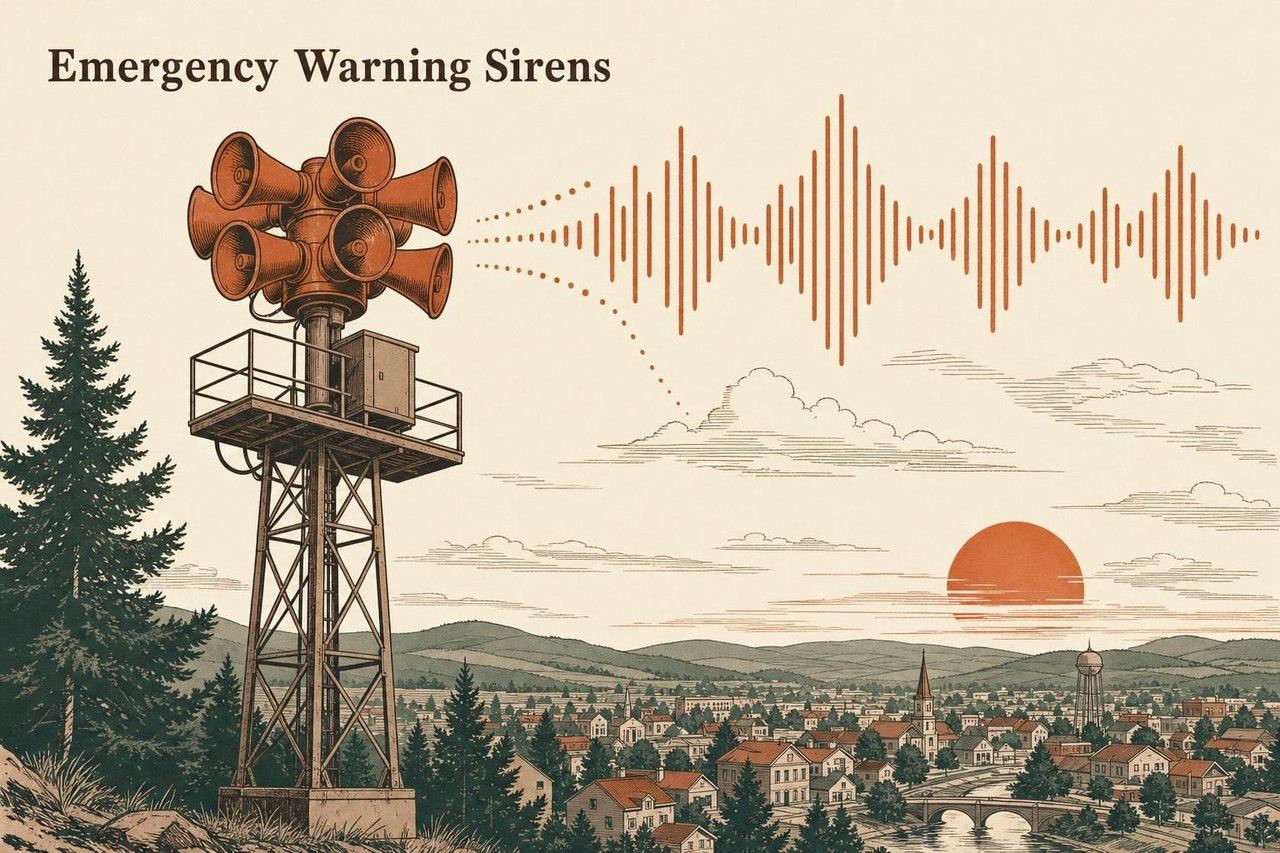
Emergency alert sound types, and a guide to their meaning
An emergency alert sound isn't one thing — it's several different systems, each with its own sound and its own meaning, and this guide covers all of the types you're likely to actually hear: an outdoor siren, a phone-based Wireless Emergency Alert, a NOAA Weather Radio tone, and an emergency alert system sound on TV or radio.
The short answer, up front
There is no single national standard for what a specific siren tone means. Outdoor warning siren systems are installed and operated locally (by a county, a city, or a utility), and the pattern that means "tornado warning" in one county may not mean the same thing in the next one over. If you hear any siren, the safe move is always the same: don't guess at the meaning from the sound alone. Get more information immediately from one of the sources below: a weather radio, a phone-based wireless alert, local broadcast TV or radio, or your county's own emergency alert page. That single rule covers nearly every emergency alert sound you'll ever actually hear.
If you remember nothing else about siren sound meaning, remember this: the sound itself is a prompt, not an instruction.
Listen to common alert sounds
Generated in your browser, not recordings. Turn your volume down before you press play.
A continuous, unbroken tone, one of the two most common outdoor siren patterns. What it specifically means is set locally, not nationally.
A rising-and-falling tone, the other common outdoor siren pattern, often used where a steady tone means something different.
The two-tone signal (853 Hz and 960 Hz together) that precedes an Emergency Alert System message on TV and radio, per FCC rules (47 CFR § 11.31), shortened here to a few seconds.
The tone pattern behind a Wireless Emergency Alert on your phone: one long tone, then two short tones, played twice (47 CFR § 10.520). This is the one most people already recognize.
Outdoor warning sirens
Most of the large outdoor sirens still in use across the US today were originally installed decades ago as part of local civil-defense networks, and many have since been put to a new use by county and city emergency-management agencies, most commonly for severe weather, especially tornado warnings in the Midwest and South, though some coastal and industrial areas use them for other hazards specific to their area.
Because these systems were built and are maintained locally, the number of tones, the pattern (a steady blast versus a rising-and-falling "wail"), and the exact meaning of each pattern are all decided locally too. A steady tone in one jurisdiction might be a general "attention" signal meaning "turn on a radio or TV," while in another jurisdiction a similar tone might specifically mean a tornado has been sighted. Some systems use the same pattern for every hazard and rely on follow-up information to tell you what's actually happening.
This is the single most important thing to understand about outdoor sirens: hearing one is a prompt to seek more information, not a self-contained instruction. The siren itself almost never tells you whether to shelter, evacuate, or simply stay alert.
Wireless Emergency Alerts (on your phone)
Wireless Emergency Alerts, or WEA, is a nationwide system run jointly by FEMA and the FCC that pushes short alert messages directly to cell phones in a specific geographic area — no app or sign-up required, and it works on virtually all modern phones by default. WEA messages use a distinct, FCC-mandated attention tone and vibration pattern, deliberately different from a normal notification sound, so it's recognizable even if your phone is on silent for everything else.
WEA is split into a small number of categories: Imminent Threat alerts (severe weather, and other hazards to life or property), AMBER Alerts (child abduction), and Presidential Alerts (reserved for national emergencies). Unlike outdoor sirens, the WEA message itself includes the actual text of the alert (what's happening, the area affected, and sometimes a recommended action) instead of a generic tone, which is one reason emergency-management agencies increasingly treat it as the more reliable first signal.
NOAA Weather Radio
NOAA Weather Radio is a network of radio transmitters, run by the National Weather Service, that broadcasts continuous weather information along with alerts for other hazards in some areas. A basic weather radio receiver, left plugged in at home, can sound its own alarm tone when the National Weather Service issues a warning for your specific county, a feature called SAME (Specific Area Message Encoding), which lets you program the radio to alert only for your area instead of every county the transmitter covers.
The advantage of a dedicated weather radio over relying purely on a phone is that it doesn't depend on cell service or Wi-Fi, and it can keep working through outages that might affect other alert sources. Several battery- and hand-crank-powered models are built specifically to be part of an emergency kit for exactly that reason.
The Emergency Alert System (TV and radio)
The Emergency Alert System, or EAS, is the system behind the two-tone attention signal most people recognize from periodic on-air tests — "This is a test of the Emergency Alert System" — on broadcast TV and radio. It allows federal, state, and local authorities to interrupt regular programming with an alert, and it's the direct successor to the older Emergency Broadcast System used through the late 20th century.
EAS messages are typically triggered by the same underlying alerts that drive WEA and weather-radio alerts, so you're not likely to be surprised by one if you're already getting alerts another way. But it remains a useful backup, especially for households that keep a TV or radio on more often than they check their phone. That two-tone attention signal is the emergency alert system sound most people already recognize, even if they've never known the name behind it.
Of all the emergency alert sound types covered here, this is the one with the longest unbroken history — which is exactly why its sound is so widely recognized even by people who've never looked up what EAS actually stands for.
IPAWS: the system tying it together
Behind the scenes, FEMA's Integrated Public Alert and Warning System (IPAWS) is the infrastructure that lets a single alert issued by an authorized agency (the National Weather Service, a state emergency-management office, a local sheriff's department) reach WEA, EAS, and NOAA Weather Radio at the same time. You don't interact with IPAWS directly, but it's why an alert about the same event often arrives through more than one channel within moments of each other.
Your phone (WEA)
A Wireless Emergency Alert arrives automatically. No app or sign-up needed.
TV & radio (EAS)
A tone interrupts the broadcast you're already watching or listening to.
NOAA Weather Radio
Broadcasts the same alert independent of cell service or the power grid.
What to actually do when you hear any alert
Knowing the sound's meaning matters less than knowing what to do next, so treat the following steps as the real takeaway from this guide.
- Don't wait to interpret the sound. Whether it's an outdoor siren, a phone buzz, or a TV interruption, treat it as a prompt to get more information, not as the full instruction.
- Check a source that gives you the actual text of the alert: your phone's WEA message, a NOAA Weather Radio broadcast, or local news, instead of guessing from an outdoor siren's pattern alone.
- Follow the specific instruction given, which will typically tell you whether to shelter in place, move to a specific part of your home, or evacuate. These are genuinely different actions for different hazards, so don't default to one without checking.
- Know your county's own alert system in advance, before an actual emergency. Most county or city emergency-management agencies publish exactly what their local sirens mean on their own website.
You can also check what's currently active for your ZIP code directly from the National Weather Service, right now.
How to find out what your local sirens specifically mean
Because outdoor siren meaning is set locally, the only reliable source is your own county or city emergency-management agency: search "[your county] emergency management outdoor warning siren" to find the specific page, or call the agency's non-emergency line and ask directly. Many agencies also publish a short public guide explaining their exact siren patterns, often alongside instructions for signing up for text or email alerts in addition to WEA.
A brief, general history: why the systems look the way they do
Outdoor warning sirens in the US trace back largely to the civil-defense era of the 1950s and 1960s, when many cities and towns installed large rooftop- or pole-mounted sirens as part of a national network built around the possibility of an air-raid or attack warning. Over the following decades, as that original purpose became less central to civil preparedness, most of these networks were either decommissioned or put to a new use by local governments for whatever hazard was most relevant to their area, severe weather most commonly, but in some places industrial hazards, flooding, or other local risks. This history is exactly why there's no single nationwide standard today: the hardware and the local decision-making both predate any modern, unified alert system, and each jurisdiction inherited its own setup instead of adopting a shared one.
Two real, contrasting examples make the variation concrete. In much of the Midwest's "Tornado Alley," outdoor sirens are tested on a fixed monthly schedule (commonly the first Saturday of the month at a set time), specifically so residents learn to recognize a real activation as distinct from the routine test. In many coastal and hurricane-prone areas, by contrast, outdoor sirens are far less common altogether, and the primary warning channel is Wireless Emergency Alerts and NOAA Weather Radio, not a siren network at all. Neither approach is wrong (they reflect different regional hazards and different historical infrastructure), but assuming your area follows the pattern you grew up with, if you've moved, is a common and avoidable source of confusion.
Checking your own phone's Wireless Emergency Alert settings
WEA is on by default on virtually every modern phone, but it's worth confirming your settings directly instead of assuming. On iPhone, this lives under Settings → Notifications → Government Alerts; on Android, it's typically under Settings → Safety & emergency → Wireless emergency alerts (the exact path varies slightly by manufacturer). You can individually toggle Extreme Threat, Severe Threat, AMBER, and Public Safety alerts in most cases. Presidential Alerts cannot be turned off. If you've ever silenced a category after a false alarm or a test, it's worth checking that you haven't accidentally left Extreme or Severe Threat alerts disabled.
Choosing a NOAA Weather Radio, briefly
If you decide to add a dedicated weather radio to an emergency kit, the one feature worth prioritizing is SAME (Specific Area Message Encoding) programming, which lets you set the radio to alert only for your own county's National Weather Service zone, not every county the transmitter covers. A battery-and-AC model that can run on either power source covers the two most common use cases: plugged in at home day to day, and still functional on battery if the power goes out during the exact event it's meant to warn you about. A hand-crank option is a reasonable backup feature but shouldn't be the only power source you rely on for day-to-day use.
When official sources disagree, or an alert seems delayed
It's not unusual for different channels to report slightly different details about the same event: a WEA message might arrive with less detail than a follow-up EAS broadcast, for instance, simply because of each system's character limits and update cadence. Treat the most specific, most recently updated official source as the one to act on, and don't wait for every channel to agree before taking a recommended action like sheltering. If a warning seems unusually delayed relative to visible conditions (a storm that's clearly already overhead, for example), local news and your phone's weather app are typically the fastest way to get a second confirmation.